
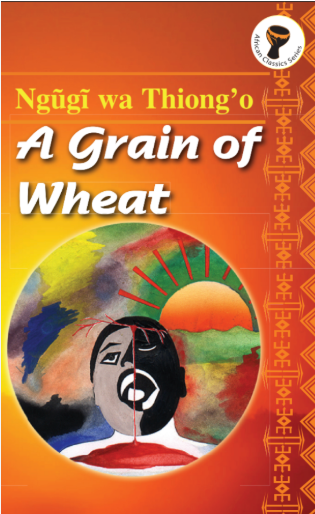
Ngũgĩ wa Thiong’o’s Grain of Wheat frustrated me. It threw all my efforts to meet it back in my face, and eluded understanding. Because I hate not finishing what I started, I fought my way through the fragmentation and the insistence of the past to invade the pages. And somewhere along the way, I began to wonder whether the problem was the book or my expectation of what a story should look like.
See, A Grain of Wheat did not follow a predictable pattern. It refused the demure linearity of a beginning, middle, and ending. And I wanted to chuck it out the window, because the story that should be my debut book seemed to have the same bug. I’ve tried to make it more interior, linear, obedient, and contained, but it rebels. In my head, the story will be prim and proper, with all loose ends tied and retied, like bows on a gift box. Here, a story that goes down easily.
Yet.
A Grain of Wheat fought me every inch down my throat. And even through my frustration and the huffs and puffs, I’m no fool; there’s something to be said of it.
Of such liminality. Of such a flow that mimics most of our lives in their lack of a clear beginning and end. In such blending of phases and seasons. A Grain of Wheat unapologetically throws us into different lives and points of view, and though disorienting at first, it became endearing once I made myself pliant enough to understand the ‘melting pot’ feel of the times in which the story is set: the culmination of the Whiteman’s rule in Kenya, the 1963 independence, and the events that lead up to and beyond that.
Flashbacks make up the bulk of the story and show us, layer by layer, that world and all its secrets and the depths of its characters. The characters. Just like my characters are headstrong, they must’ve pushed and pricked Ngũgĩ while he wrote them. Or maybe he was wise enough not to fight.
But the characters…
They seep into your skin until you feel for them. And they are not trying to, either. They are just people living, dreaming, fighting for their life, with some luck and a good dose of bad luck. And slowly, you find that you understand them deeply and they come alive in your mind.
Mugo’s increasing mental fragility is a beautifully written tragedy. Here we have a man who battles with guilt, fear, and the desire both to be loved and to be left alone. Ngũgĩ paints us the pressures we put on people through our expectations of them, a cautionary tale to revise how we understand people, and a character whose identity is built partly through what everyone else believes about him. Mugo is both devil and messiah, but aren’t we all?
Karanja, with his unrequited love and desperate search for importance through colonial rule, reminded me of The Boondocks’ Uncle Ruckus. How sad it is, that people can begin at the same place, are equipped equally, and end up at wildly different points. But even sadder was his determination and belief that Kenya needed colonial rule like they needed air. Perhaps, that is one of the cruelties of oppression: those who are less oppressed can become invested in the system that distinguishes them from their fellows.
Gikonyo and Mumbi’s story was beautiful, heartbreaking, sad, hopeful, and strangely soothing to my soul. It was love that did not bend to the usual trope. Ngũgĩ did not write boy meets girl, they fall in love, vanquish a jealous ex, and live happily ever after. It didn’t even feel like love in a lot of the pages, and those butterflies died a gruesome death to reality. Yet, towards the ending, I realised it was the boldest sketch of love I’ve ever read.
The end is by far my favourite part of the book—that beautiful sketch of reconciliation and hope—but of course, its weight and beauty come from the accumulation of the pages before it. Usually, the end is the end, and we should be satisfied with the perfect wrapping. But who says the end is always the end?
Because in the end of A Grain of Wheat, all the fragmented voices and perspectives come to a head in both a breaking of an illusion and a breaking of the earth for something new to spring forth.
For hope, especially in the image of the woman, rounded with child.
And maybe for me and the story that will not bend without drawing blood.

