
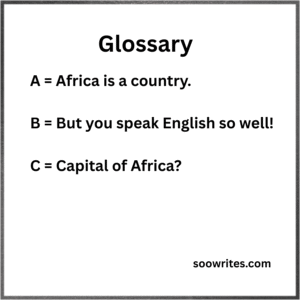
Glossary (Oxford Dictionaries): an alphabetical list of words relating to a specific subject, text, or dialect, with explanations; a brief dictionary.
A glossary is a list of explanations of new words usually found at the beginning of a piece of writing. I remember returning to the glossary of a book to find the roles of the characters whose names would not stick. I was ten then, and that is the only justifiable reason for a glossary in my books. Pun intended.
The only other time glossaries have been justified are in science fiction and fantasy books, where we are thrust into new worlds with made-up terms and rules. But even this can be avoided with strong contextual clues.
Over the years, I have read my fair share of novels and have found a concerning truth: African novels like glossaries. Their authors may not, but the novels themselves tend to lean towards glossaries.
The debate about whether to gloss or not has been long standing, with solid arguments on both ends. For some, glossaries are signs of novels trying too hard to be liked, and for others, they are important for universality. I am on the side of the former. Glossaries are good for textbooks and academic pieces but should have no place in fiction.
And glossing does not always happen in the preliminary pages of a book: these explanations take many forms. For example, the use of ‘black-eyed peas marinated in palm oil sauce’ to mean beans in Chigozie Obioma’s The Fishermen; writing a word and immediately proceeding to translate it; italicising local words; and over-explaining a term.
With Chinua Achebe, we learn that we are meant to colonise the English language, in a way of keeping our work accessible to a global audience but retaining its authenticity. In essence, we must bend the English language to our will by playing with length, with prose, and with symbolism that are decidedly African. Chimamanda Ngozi believes that if we have to explain a word (gloss), our context isn’t doing enough work. To her, glossing is a sign of weak technique.
The glossary explains. But to whom? Does it explain eba to those who turn and swallow it with oha soup? Does it explain ikenga to those who understand it already? And if it is trying to make work accessible, does it mistake understanding for comprehension in that a word must be fitly translated into English language before we can universally understand the meaning?
Understanding is the grasping of a basic concept, and it is something that does not demand translation, only context, only the ability to link known concepts with foreign ones. When we read about a woman doing omugwo in her daughter’s home, we must not have the literal translation to see that she is there to help the new mother. Yet, we don’t have to translate a word to our own native tongue to understand what it means. This preference for context is something every reader must have.
Researching the cultural nuance and importance of omugwo is a step towards comprehension, and a more dynamic relationship with the text. This is a level most readers do not get to.
Yet it is also something, which, if wielded correctly, will improve the novel experience both for natives and foreigners. Most of my aha moments when reading English novels came from researching the meaning of the words and applying that knowledge to the book I was reading. To read a book and get all its translations in the same breath is a lazy approach to reading, and takes away the intimacy of finding, and of truly knowing. Glossing robs the reader of this intimacy—this find.
And like with untranslatables, a lot is lost when a thing is reduced to a definition. I believe that if a word is so integral to the story that it must be understood by everyone who sees, a mere definition in the glossary will be grossly inadequate to carry that weight—that importance.
And the issue of glossing is not always a matter of writing technique. Sometimes, it is a matter of institutional necessity. Some writers gloss because their non-African editors look out for their readers so passionately that they attempt to remove every potential barrier to totally understanding the text and all its elements. Of course, this results in a watering down of the original.
Other times, it is specifically a matter of writing technique and a lack of confidence. Some writers gloss because they believe they have the responsibility of making everyone understand their story. ‘Look, my story. Do you get that?’ Like explaining a joke so everyone in the room gets the punchline and laughs. But like with jokes that are explained, glossaries steal the punchline from the book they explain.
So, to gloss or not to gloss?
To write, believing your story can reveal itself to your readers without losing parts of itself in exhaustive explanations.

