Remember when we spoke about flashbacks? About how they are the past cutting into the present to achieve a goal or the other? Well, in the spirit of that, we’d be talking about something that deals with future events: foreshadowing.
Although it is seen as the opposite of flashbacks in some circles, it is not. That position is taken by the apter term ‘flashforward’ which is when a future scene is put into the present scene.
But this is no ’words and their opposites’ so let’s get on with it.
FORESHADOWING.
While flashbacks are a dip into the past, foreshadowing is a technique that has to do with the future. Foreshadowing is a writer giving their reader a hint about something that will happen within the story, and it is used to create suspense and believability.
In its barest form, it may look something like this: if only she knew that would be the last night she’d smile.
Yup, it is telling and crude, but it does the job of getting the reader to ask ‘why?’.
Why would this be the last night she smiles? What horrible thing is about to happen?
And to find the answers to these questions, the reader reads on. With more trepidation, yes, but also with a higher level of intrigue.
TYPES OF FORESHADOWING
Direct Foreshadowing: This is when the writer explicitly suggests a future twist or plot development. This may be done in the story’s prologue or within dialogue. This is usually done to create suspense because the readers know what will happen, or that something will happen, but would read on to find out how it will happen.
A good example of this is the prologue in Happy Stories by Sophia Obianamma where Amara buries her daughter and gets ready to leave the village for good.
“Stop this, Amara, we cannot question God. Let us bury the child and go inside. I’ve spoken with the orphanage in the city, and they have toddlers up for adoption.”
He doesn’t look at the child as he says this. Amara knows why—he cannot comfort her if he comes undone.
Amara drops the child into the earth and dusts her gown, ignoring the red of her daughter’s blood.
“You will be the last one I bury,” she says, dropping her daughter’s ‘iyi ụwa’ into the grave.
She had begged and given the child everything she demanded, asking for her tether to the spirit world and the girl gave her a useless pebble. She should have known better, demanded for the bones and strings, crushed the pebble into powder. She should have asked for spiritual help.
It is true what they say, you cannot reason with ogbanjes. She never should have bothered.
The couple walk into their home, letting the early crickets serenade them on yet another sad day.
Hours later, as the moon reaches its peak, the dead girl stirs. Slowly, her life force seeps into the pebble in the soil. A body will decay, but a rock will not.
👀
We know dead bodies shouldn’t stir. We also know there is something sinister about this transfer of ‘life force’ from a relatively fast decaying vessel to a slower one. It makes you want to know what happens even though you know that whatever it is will not be good.
Grab a copy of Happy Stories (Novella) here. In case you didn’t catch that, that’s my novella.
Indirect Foreshadowing: This is a subtler form of foreshadowing. The writer leaves hints in the story and lets the reader make the connections on their own. This type of foreshadowing is usually appreciated retrospectively. For this type of foreshadowing authors use thematic elements like symbolism, where a symbol is used to hint at a future event.
For example, in Chinua Achebe’s Things Fall Apart, the swarming of Umuofia by the locusts is symbolic of the coming of the white men.
“At first, a fairly small swarm came. They were the harbingers sent to survey the land. And then appeared on the horizon a slowly-moving mass like a boundless sheet of black cloud drifting towards Umuofia.” Page 55
Later, Achebe makes this link clearer with a direct statement.
“…I forgot to tell you another thing which the Oracle said. It said that other white men were on their way. They were locusts, it said, and that first man was their harbinger sent to explore the terrain…” Page 59
At this point, we think ‘if the white men are the locusts, coming to survey the terrain before descending in their numbers, what else do we know about the locusts in the story?’ We know they did what locusts do and consumed everything in their path.
The only reason the people of Umuofia did not feel the devastation of the locusts’ arrival was because the locusts arrived after the season of harvest and ate the remnants in the fields. Putting two and two together, suddenly, we understand that something horrible is about to happen and it involves the white men descending on Umuofia in their numbers.
A third type of foreshadowing I’d like to add is Chekhov’s Gun.
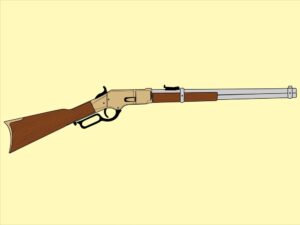
Chekhov’s Gun: This is a literary principle by Anton Chekhov that states that ‘no object should make false promises’ in fiction/film. He says, ‘one should never place a loaded gun on the stage if it isn’t going to go off. It’s wrong to make promises you don’t mean to keep.’
What this means is that writers should not introduce a person, object or thought into their writing with an air of importance only to completely ignore it for the rest of the story. The presence of the loaded gun, and we’d know it’s loaded when the writer hints at it, is a form of foreshadowing that readers would keep in mind.
If nothing is done with the gun, it becomes a loose end, and loose ends are bad for stories.
Remember that I mentioned ‘believability’ somewhere up there? That was my sad attempt at foreshadowing.
I did that to mention now that foreshadowing doesn’t just create suspense but also helps the reader believe the events of the story.
Using the principle of Chekhov’s Gun literally, if there is a loaded gun in the room and the main character looks at it every time they have an argument with their roommate, if in the future, they shoot their roommate over a slight argument, readers would believe it. They already know the protagonist has been itching to do that, even if the character themselves are not explicitly aware of this desire.
If, instead, the author doesn’t foreshadow this desire and everything is all fine until the shooting, the suddenness of it will override the reader’s need to believe the story (especially if the author doesn’t give an explanation later on).
So, there you have it. Foreshadowing, its types and its uses. Complete with sweet examples.
Writers, go ye now and foreshadow the heck out of us with your novels. And when you’re done, don’t forget to bring them over for a thorough round of line editing by yours truly.