
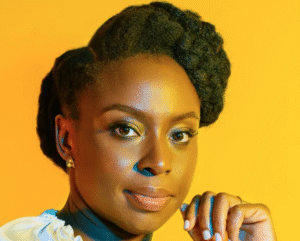
Chimamanda Ngozi Adichie is a literary legend known for her thought-provoking and beautiful prose. Purple Hibiscus, Half of a Yellow Sun, and a host of short stories by the author are all rife with her strong voice. These works, though they may address other issues on the surface or in conjunction, have one thing in common: Feminism.
The term ‘feminism’ brings bitterness to many mouths. This might be because it has been abused by some women who reduce it to a term for vitriol-spitting man-haters, or because it says that women are humans and should not be subjugated, and this statement does not sit well with those who wish to keep women at the bottom rung of the social ladder.
Whatever the reason, the ignorance surrounding feminism and the feminist movement even by those who practice it, is a huge problem for us. Female writers like Chimamanda whose works are rich narratives pushing the feminist agenda can show us what feminism really is by how they portray it in fiction.
For clarity’s sake, here’s Chimamanda’s definition of a ‘feminist’:
a feminist is a man or a woman who says “Yes, there’s a problem with gender as it is today, and we must fix it. We must do better.”
See? No preaching for women to become ‘prostitutes’, no rallying with placards that say ‘men are scum’, no shouts about women being better than men. Feminism isn’t to one-up men, but to address the systemic gaps between men and women that grossly disfavour women.
Themes of feminism in Chimamanda Ngozi Adichie’s novels and short stories.
First, Purple Hibiscus, her debut novel. In this work, Chimamanda exposes a common issue in society where men abuse their wives as they take on a tyrannical and authoritative position in the home.
Mama (Beatrice) endures humiliation, emotional and even physical abuse from her husband which results in two miscarriages.
Mama starts off as the ‘ideal’ African woman: the one who stays quiet and silently endures the abuse. You know the type. The type born from the advice ‘just keep quiet and pray, God will touch his heart’ or ‘next time, don’t anger him’. But towards the end, she has enough of being a punching bag and having her autonomy stripped from her and so, lashes out.
Half of a Yellow Sun is, on the surface, a novel about war and its devastation but there are unmistakable feminist themes in the book. We see instances where the male child is considered superior to the female child.
Anulika wants to have a son first because that would “place (her) feet firmly in Onyeka’s house”. This means that a female child equals a rocky stance in her husband’s house. She tells her brother, Ugwu, ‘You know, Onunna from Ezeugwu’s compound had a baby girl first, and her husband’s people went to see a dibia to find out why!’ These thought processes place so much pressure on women in our society. I talk about one such pressure here.
Then, when Amala’s prized pregnancy produces a girl instead of a boy who would carry the family’s name, both she (Amala) and Mama suddenly do not want to have anything to do with the baby.
“Mama doesn’t want to keep the baby.”
“She doesn’t want to keep the baby?”
“No.”
Olanna knew why. “She wanted a boy.”
“Yes.”
Half Of A Yellow Sun, P.306
But even in this, Amala may be more of a victim than a homewrecker. She was a simple village girl forced to sleep with Odenigbo and carry his child. Amala had no agency and was instead a pawn in Mama’s schemes to have a grandson.
Before we say she could have said no, let Olanna show us how else to look at the situation.
Amala mumbled something. Finally she turned her face toward them and Olanna looked at her: a plain village girl curled up on the bed as if she were cringing from one more furious blow from life. She never once looked at Odenigbo. What she must feel for him was an awed fear. Whether or not Mama had told her to go to his room, she had not said no to Odenigbo because she had not even considered that she could say no. Odenigbo made a drunken pass and she submitted willingly and promptly: He was the master, he spoke English, he had a car. It was the way it should be.
…
Olanna was watching her. Perhaps it was hate she felt for Odenigbo. How much did one know of the true feelings of those who did not have a voice?
Half Of A Yellow Sun, P.306
This is another issue Chimamanda tries to bring to light with Amala’s story. This part broke my heart.
Amala said nothing for a while; she spoke so seldom that her voice always surprised Ugwu by how childishly high it was. “Pepper can remove pregnancy,” she said.
“What?”
“If you eat plenty of hot peppers, they will remove pregnancy.” She was huddled in the mud like a pathetic animal, chewing slowly, tears streaming down her face.
“Peppers cannot do that,” Ugwu said. Yet he hoped that she was right, that peppers would indeed abort the pregnancy and his life would return to what it was before: Olanna and Master securely together.
“If you eat enough, they can,” she insisted, and reached out to pluck another one.
Ugwu did not want her to finish the peppers he so carefully cultivated for his stews, but if she was right about what the peppers could do, perhaps it was worth it to let her be. Her face was slick with the moisture of tears and mucus, and once in a while she opened her mouth and extended her pepper-burned tongue to pant like a dog. He wanted to ask why she had gone along with it if she did not want the baby. She had gone to Master’s room herself, after all, and she must have known about mama’s plan. But he did not ask; he did not want her friendship. He turned and went back inside.
Half Of A Yellow Sun, P.293
How many Amalas do we have out there? How many women are forced to go along with plans such as this? To surrender their body to be used on the altar of someone else’s posterity? To bow to a Matriarch or a Patriarch just because they are a woman? How many women are voiceless pawns who have never been asked ‘what do you want?’ How many times has an Ugwu seen an Amala in pain and looked away?
Amala was wrongly used, and Chimamanda puts that mirror in our faces. See? See what feminism fights for? These women who do not have a voice of their own. Who do not know they are allowed to say ‘no’.
Chimamanda is a feminist. And in case we somehow missed that from her works, she published an essay titled We Should All Be Feminists where she talks about her experiences with the word ‘feminism’ and why everyone should be a feminist. You can read that here.
But to answer the question of today’s blog post, yes, African fiction (especially when written by women) does not shy away from the topic of feminism.
And works with the feminist theme (using Chimamanda’s works as a focal point) employ different methods of dealing with the issue of toxic patriarchy and inequality of the sexes.
Some only raise a mirror and let us determine what is right or wrong for ourselves (Amala’s plight as a secondary character in Half of A Yellow Sun), others allegorically demand the fall of patriarchy (Mama’s actions in Purple Hibiscus and Nonso’s fall in Tomorrow is Too Far, both by Chimamanda), while some show us female characters who stand up to toxic patriarchy like in Jumping Monkey Hill (Chioma’s mother who refuses to beg Chioma’s father to return home after his foolishness and fragile ego send him packing and Chioma herself who confronts her lascivious interviewer when he gropes her breast).
Feminism in African fiction is loud and bold and all the things feminism is, and it is only getting bolder each day.

