Note: I wrote this review a few months ago (immediately after reading the book) and have since moved on to other books. I still maintain my stance on the book, although my fan-girling embarrasses me slightly. I try not to spoil the book for you, so you’re welcome. I hope you enjoy this review as much as I enjoyed writing it.
It ended abruptly. Too abruptly. And this might be a premature response since I am writing this only seconds after the last page with a mouth full of moi-moi (and I’m always hyper while eating), but I believe even months after this I will maintain that the book ended abruptly. And that is the only thing I did not love about it.
Now that its one unforgivable flaw is out of the way, we can move on to the gushing.
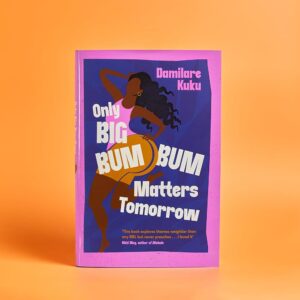
I didn’t know why the name sounded familiar until I read the section ‘A Note On The Cover’ and realised Damilare Kuku was the author of the iconic Nearly All The Men In Lagos Are Mad. Makes sense, man, makes mad sense. Greatness cannot be hidden!
When I told a friend that I was reading a book titled Only Big Bumbum Matters Tomorrow, he thought I was on to one of my grand imaginings and played along until he realised I was serious. A testament to the startling title.
Only Big Bumbum Matters Tomorrow is Damilare Kuku’s second novel, and a novel worth reviewing! I am shamelessly fan-girling.
The story follows the lives of five women in Ile-Ife bound by familial ties. We are introduced to the story by one of our protagonists, Temi, who announces, during the reading of her late father’s will, that she plans to get a butt enlargement surgery. It is as we read on that we realise that the story is not Temi’s alone, but that of five women living and being. I’ll take each woman as a case study without spoiling the book for you.
First, our dear Temi: Temi is in her last year of university and wants to go under the knife because she believes it would make life easier for her. At first glance, this seems like youthful stupidity, especially as we are made to believe that her reasons are superficial—everyone is doing it, and a fixed backside would mean access to doors shut to flat butts.
So, it seems silly that she is obsessing over a bigger butt (an expression of vanity) and everyone in her family thinks so. Her big reveal spurs a chain reaction that effectively introduces the other protagonists.
Ladun: Temi’s older sister who is bitter for the most part of the story. At first, she is the mysterious child who left her family five years ago and only returned because of her father’s death.
However, as we read further, we see a sad child hurt by a truth she could not bear. We also see the consequent fight to make sense of life and the hand she’s been dealt. Ladun returns to Ile-Ife after years away and starts her long overdue redemptive arc.
Maami (Hassana): Not just a frustrated mother and bereaved wife but an individual in her own right. Strangely shocking. You mean parents aren’t just ‘daddy’ and ‘mummy’ but actual people with actual people experiences and thoughts? Hassana has a past chock full of thorns, and an uncertain future now that her beloved husband went and died prematurely leaving her with one daughter who wants to enlarge her buttocks and another who cannot stand the sight of her own mother.
Aunty Jummai: Loud and sincere and loves feeding people. She is also a woman forced to do life alone even though she stays with her disrespectful nieces and her sister, Hassana. At least her brother in-law appreciates her as a person and doesn’t see her as a pest—that is, before death took him away. Oh death, where is your sting?!
Lastly we have Big Mummy: The odogwu herself. The woman whose own brother left her nothing but who has attained such a level of self-sufficiency and grace she can be there for his surviving family with no qualms. Afterall, who else will keep those stubborn girls of his in line? Is it that northern woman he married?
The thing about good stories is that they entertain. The thing about great stories is that alongside the entertainment, they educate, and they educate well. Here is a list of topics Damilare weaved into her great storytelling.
- The male gaze.
- Societal expectations.
- Bitterness.
- Forgiveness.
- Love in its various forms.
- Childhood trauma.
- The transience of life.
- Dependence.
- The ugliness of life.
Now, I won’t bare these out for you to see; instead, I’ll go the novelist’s way—weave them into entertainment and hope you peel back the layers to see the issues for what they are.
Lepa Shandy wants to be seen (Childhood trauma, insecurity and the need to be seen)
Temi is plagued by a deep-rooted insecurity about her backside which is not only flat but appears inverted. Despite what her family says (maybe even in spite of it, because how would you claim to love me when you don’t even see me?) she has been told right from time that the love she deserves as a woman depends on the size of her backside.
It is not a sudden madness, or a strange coping mechanism to her father’s death—it is a hum drilled so deep into her subconscious mind nothing anyone can say would change it.
Was it the taunts from the boys in her school whose mothers probably still bathed them? Was it the effrontery of the rider who tapped her butt and commented on its flatness? Was it the casual conversations around ‘big bumbum’ being someone’s spec?
For a growing child who has no control over how her body morphs and whose silent suffering is made even more silent by the fighting elephants in her home, a bigger bumbum really is the only logical solution to Temi’s plight.
Feeling invisible? Get a big bumbum for .99 naira
Temi’s inability to even court the possibility of being liked by Chuka is a painful truth. Our insecurities really direct our actions whether we like it or not and can warp our perception of things.
Whatever he would do or say to convince her that he sincerely likes her would fall on deaf ears because she does not like herself. If she ever gives him a chance, he would constantly have to compete with the toxic voice in her head, and that, ladies and gentlemen, is a competition rigged against him from the start.
Ladun the mysterious (Shame, anger, and stumbling in the dark)
Ladun is broken. If a man were to describe her, they would say she was beautiful, but they would not mean the beauty that radiates from inside out and that is present in the little things and the pure graces of her being. They would mean the beautiful that stops you in your tracks and makes you want to collect her like you collect beautiful things.
If Temi’s problem is being invisible, Ladun’s is being too visible. Too visible too young, but as we’d see from her mother, too beautiful while older is still quite dangerous for a woman.
Ladun wants everyone to stop looking at her—to find better things to do with their time than stare and compliment a face she got from a parent whose sin is too great to forgive. With Ladun, we see the ugliness of the male gaze and how what society tells a woman she should be grateful for (a startling physical appearance) is a viper ready to strike her.
Of course, age is not a number when beauty is transcending. Of course, a child can be kissed and touched because she looks like a gazelle and has begun to sprout parts that should belong to a woman.
Ladun is angry. She was the perfect child: good grades, good behaviour, healthy. She was everything they wanted until she realised she was a lie and her life shattered. Like with glass, a heart can be broken in many ways.
Ladun reacts to things. Every action feels like it is caused by an external force. Leaving the house, staying away, Edache. She is pushed and pulled by Adunni and we don’t really get to see her make choices for herself. She feels like a little girl stumbling through life with spikes to protect her from the venom of men, the truth of her heritage.
I love Ladun though, because Ladun loves her sister and her family more than life itself, even as she struggles to love her body.
How can you love a body that does nothing but pull salacious gazes to it?
Even the beautiful have scars (Love, satisfaction, and the unfairness of life)
Hassana really has her work cut out for her with her daughters. The older one hates her and the younger one has run mad. Because why would a child want to enlarge her buttocks? Isn’t it to pull men towards her? Does her youngest daughter even know the dangers of being wanted by men?
Hassana is like sweet wine, aged finely. Her life pre-Tito is intriguing. It is like being privy to a secret, a past life. Like watching your mother while she was young and seeing as the plant becomes a tree.
Hassana’s character is strong. She had a mother who could not love (because she was not loved herself), a sister who let anger stop her from loving Hassana, a man who loved her beauty alone and another who couldn’t love her when she was broken.
At her core, Hassana is starved of love, and that is why Tito is the person for her. Oh, their love story deserves an essay. Tito’s encompassing love for Hassana was the salve she needed to move forward after the many curveballs life threw at her. And he did not love only her beauty, but her—every part of her and everything that came forth from her.
Oh, to be loved like Tito loved Hassana.
Hassana is judged by her looks. Being this beautiful, one is expected to be dumb. God shouldn’t give one person everything. But the fact that she did not go to school does not make her stupid.
I love how industrious she is and how, despite what society lowkey expects of someone with her beauty, Hassana doesn’t dream of trading her beauty for favours. She has no grand plans like her sister Jummai because we cannot all have grand plans and big dreams.
Some people are fine with being comfortable, and that is grand in itself.
Fire for fire, until fire fizzles out (Ups and downs, pain, and rough edges)
As a youngster, Jummai acts in anger. She is the hot-tempered one while Hassana is the calm one. Fire and water. Unfortunately for her, their mother is also fire and a collision of fire just burns.
Jummai loves hard and she loves her sister, but for all her dreams and imaginings, she forgets her sister is not an extension of herself and gets angry when she is confronted by her older sister’s individuality.
This youthful anger costs her a sister but, thankfully, also saves her from an abusive marriage.
“Perhaps he would have preferred if he was the one doing all the hitting”
Jummai moves from being a wildfire to reserving her wildness for prayer time. Her life shows that life really is not linear. She had her wins and she had her losses and she loved and she lost and now she just wants to make sure her niece doesn’t do anything stupid under the influence of that spirit of big bumbum.
I mourned her relationship with her sister because I know how beautiful sister bonds are, but I believe there is hope yet for the sisters, beyond the pages of the book. Jummai’s loudness and forwardness are strangely refreshing.
She is not bound by the societal expectations that a woman be silent and meek but says her mind and says it loud enough that you can still hear it tomorrow.
Her unbridled sexuality and her unrepentance were a curious thing to me, but a pleasant reminder that we come in different characters and shades. A scene that stood out to me was her classroom ‘sweating’ session with Observation. I was aghast at her effrontery, especially because she identified as Muslim then.
Later, this shock from her actions muted into slow respect that she had the audacity to live her life as she wanted, and how many of us can claim to truly live?
To be the bigger person (Fanaticism and want)
Big Mummy is the definition of hurt people hurt people because why would you be so wrapped up in your pain and your hope for a solution that you forget to channel the humanity in you towards your little nieces? If you’ve read the book, you know the scene.
For me, Big mummy’s story was somewhat hidden under Jummai’s because they were slightly similar but Jummai’s voice is louder. Big mummy has a hole in her life she is determined to fill, and she would go to any lengths to pour that cement in. I don’t have much fodder on Big Mummy, but I like her, the way I like the other women in the book—flaws and all.
Here are a few scenes that stood out for me.
- When Jummai broke a male customer’s fingers for touching her without consent. It wasn’t just the fact that she broke them, but the humour in knowing that her original silence wasn’t consent but contemplation.
- When Big Mummy found her husband and roped him to her. Eish! Woman, why so wicked? That was pure villainy, and it gave me a good chuckle!
***
Something of note is the fluidity of religion in the book. It was how these women, especially Jummai and Big Mummy, had faith first before religion. The alfa, the pastors, the prophets, all leaders and guides for their faith.
I loved how I could not guess the direction of the story or of the lives of the women whose stories were told. It was beautifully random, like life, and made sense where it needed to make sense but otherwise…life.
There were relationships destroyed by anger, there was forgiveness, there was acceptance, there was hugging the other person even when they had thorns on them and when you could not understand them, there was fire and there were flaws.
I thoroughly enjoyed the book and raved about it to my friend after he got over the shock of the title.
Damilare Kuku did a good job with Only Big Bumbum Matters Tomorrow.
So, tell me, would you grab the book now that you know what it’s about?