
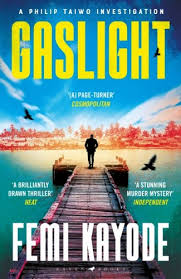
I’ve not read many Nigerian crime novels and all that comes to mind right now is Oyinkan Braithwaite’s My Sister, The Serial Killer, although that was more thriller than crime. Gaslight, by Femi Kayode, was an impromptu read—I’d just finished reading a novel and was about to hunt for a title on my TBR list when I stumbled on it. Because someone mentioned it alongside the amazing The Silent Patient, I picked it up and do not regret that decision.
I’ll confess now that although I was itching for the truth to be uncovered, and I knew that would only happen at the end, I didn’t want the novel to end because an end meant getting ejected from Detective Taiwo’s world.
For the uninitiated, Gaslight is a novel about the mysterious death of a Bishop’s wife. The book starts off with instructions on how to bring the Bishop to his knees, planting doubt in the reader’s mind from the get go, and doesn’t lay off the mystery even as we peel back layers. And oh, are there layers! Following a public arrest, Bishop Dawodu is suspected (framed?) for his wife’s murder, but there is no dead body to support this claim, only a missing wife known for her random disappearances.
Why would the police conclude his wife is dead? Why would he kill his beautiful wife whom everyone knows he loves to death? Pun intended. Why would anyone want to frame the Bishop for this? And most importantly, what happened to this mysterious wife, Sade Dawodu?
Back in Nigeria after a traumatic event in the states, Detective Philip Taiwo gets contracted by Grace Church to find their missing First Lady and clear the Bishop’s name. His investigations lead to more questions than answers, and when a body turns up in the Lagos Lagoon, his job becomes immensely harder.
With more digging comes resistance and warnings from anonymous people to get off the case. There is something at play here, and it is bigger than a little couple fight as the Bishop would have the detective believe, bigger than a temperamental First Lady away on one of her retreats as the church elders insist.
Something large is at play, and though it threatens to drown the detective should he get too close, Sade Dawodu is the answer. The problem is, she is nowhere to be found. But even in absentia, she passes judgement on those who wronged her, and detective Taiwo, although not a part of her original plan, helps her in his own way.
Now, as to why I enjoyed the story. Why wouldn’t I? There was murder, there was intrigue, there were questions and a sly mastermind who made the hardest decisions. I enjoyed how evenly paced the story was–not once did I think of pace while reading it, which is a good sign. I enjoyed how I could picture everything and how this book, like all really good books, will remain in my memories as visuals.
Every character had such distinct personalities that they filled the gaps in the author’s minimal description of their physical appearance. And this is something I love about stories: personalities force me to know these characters more intimately than just their looks.
It was also easy to suspend my disbelief and go with the flow because nobody ever went out of character. Not the elders, not Kenny, not Folake, and not even Lara with her teenage angst. I enjoyed the novel’s plausibility—the author did not insult our intelligence by having incredulous things happen, like cars flying over other cars in a high-speed chase or one man taking down fifteen mercenaries.
Similarly, the author did his best to not make me feel like a fool, which I am grateful for and which definitely added to my enjoyment of the story. See, I’m not a huge fan of crime novels, but since I grabbed the book, I hoped to at least understand some concepts, if not everything the experts would know. The author made this easy for me by explaining the situation when necessary and always subtly enough for these expositions to feel ‘normal’. I never felt like I was being lectured.
I liked Folake. Although she came across as cantankerous, I saw why she was that way. Her need to prove something came from being both female and black in a world that punishes either and that means her life must have always been an uphill battle.
I especially loved the scene where she appeared as Taiwo’s legal counsel and ran Detective Bello into the mud! (Read the book if you’re curious) There was something liberating about her sharpness and person, and I enjoyed it just as I enjoyed her when she was a laughing godmother or a rested wife.
I think the story ended well—everyone got taken care of, the guilty and the grieving.
Unfortunately, no matter how amazing it was, Gaslight is not escaping my grouse.
The reason for their return to Nigeria is a loose end for me, and I don’t know if the answer is in the author’s debut novel, but I have questions! Taiwo hints that their reason for leaving the states was a secret—some ‘insurmountable wedge’ that compromised any leverage he might have—but we uncover, chapters later, that a police altercation was the major propellant.
So, what really happened?
My first guess was that there was infidelity, but after the police altercation I guessed he might have been using. Also, what happened after the hit to his head at the Airbnb they rented? Questions, questions. Anyway, the author doesn’t tell us what really happened and I don’t like loose ends, so that’s points taken from the book.
Besides this, Gaslight was an interesting read and I honestly didn’t want it to end. If you’re a fan of good writing and want to know what happened to Sade Dawodu, grab Gaslight now and thank me later.

