
I cannot quite remember if her name was Mrs. Hajara or Mrs. Hassana, but I know her son, Abdulrasheed, was my friend in those days when boys and girls could be friends without fear. I also know that she taught us Hausa Language and even though I never spoke Hausa outside her class, I enjoyed those classes more than all the others. Why else would those be the only classes I can remember with such clarity from Secondary school.
It might have been the allure of reading a language that was not mine, but I would argue that that paled in comparison to the fact that we learnt through fiction. And if you know me, you would know I am a fiction girl through and through.
Mrs. Hajara (because this rings more familiar) was a kind and soft-spoken teacher who always had a gold ring in her nose and who never failed to cover her hair. She had wisps of grey hair that would peek out her scarves and her beauty was an elegant kind of beauty—dark skin that accommodated creases, soft eyes with something mischievous beneath the surface. It always felt like there was a joke her eyes laughed at that I was not old enough to grasp—a joke that had nothing to do with any of us. She read us Ruwan Bagaja and Iliya Dan Mai Karfi and would patiently explain anything we found difficult.
Ruwan Bagaja was this orange book that had pictures of men in turbans and face coverings sitting on mats while conversing—conversations I mouthed with glee.
I can never forget the book cover for Iliya Dan Mai Karfi or the transient and muted imageries of Iliya’s adventures.
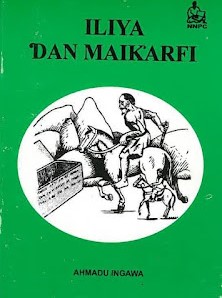
I haven’t honed my skills in a while, but I can manage to read Hausa texts and I’ve been told I write Hausa well—I don’t think I do, but who am I to complain?
The Late Ngugi Wa Thiong’o, may his soul rest in peace, would’ve been glad to hear this story. He was, after all, a proponent of the use of indigenous languages in fiction. The Kenyan writer, late in his career, became a staunch advocate of ‘decolonizing the mind’, a theory of his which argues that writing in English is just an extension of enslavement. He did not believe in Nigerian or Kenyan English, which are supposed to be our own version of the global language (a form of localisation or mutation) and instead completely rejected the use of English in literature.
According to Ngugi, language carries culture, and culture is the foundation of any literature that arises from a place (community or country), so writing in English or French as an African means dropping your culture in favour of a foreign culture. And because culture really encapsulates a people’s value and sense of self, writing in a language that is not African means that our values and experiences cannot authentically be expressed through our literature.
Then, of course, there is the issue of translations and the subsequent dilution of these concrete cultural realities. You can read this here.
You will find, in that post, that Chinua Achebe advocated for African writing to be done in English, for the purpose of globalising our work. There has been a longstanding debate between writing in English and writing in indigenous languages, with Chinua Achebe and Ngugi Wa Thiong’o as spearheading oppositions.
I am not interested in the debate.
I am, however, interested in the fact that not many of us have had such an experience as I did with my Hausa studies. When I was taught French, I passed, but all I remember is our huge French teacher who was actually a French spy and could tear through twenty armed men with her right hand only (in my imaginations at least). Imaginations because the classes were otherwise drab. There were no stories, no pictures, just plain old ‘Lundi and may crazy’.
Most of us grew up on stories—because stories are easier to assimilate as kids—and these stories helped shape our perspectives and understanding of the world. Most of these stories were European, and though we have come a long way from that, that kids in the future would read African fiction written in English and with English rules of writing is a matter of concern to those who subscribe to Ngugi’s ideology. That children will learn English as a compulsory subject and have indigenous languages as optional can and does propagate the feeling that English is somehow superior to our local languages.
How do we create systems where African children are taught literature written in their native tongue?
Of course, here, we must confront the quixotic nature of this question because in Nigeria alone, we have about 500 different languages and what curriculum can handle that much diversity?
At the risk of sounding idealistic, I would like to argue that though we may not get to a point where our texts (all the books available in libraries and bookstores) are solely written in indigenous languages, we might manage to infuse African literature with African languages such that schools can adapt these works and students are introduced early to books written by and completely for them.
We have a diverse pool of Nigerian writers writing amazing fiction in English. If we had the same number of writers, or translators (all to the same end) writing in their indigenous languages, there will not only be markets for these books but a total revolution where Nigerians appreciate their languages even more and the masses not interested in English find representation and acceptance in fiction.
Oh, but beggars would ride.
In the meantime, I understand were both Chinua Achebe and Ngugi Wa Thiong’o were coming from, though I lean more towards Ngugi’s ideology. I cannot for the life of me write in Igbo, so I would have to write in English and hope the language does not stifle the rotundness of the culture I write (it isn’t actually this dire) while advocating in whatever way for the rise of African fiction written solely in indigenous languages.
If for nothing else, then for the girl who eagerly flipped through pages of Iliya Dan Mai Karfi gawking at the strange and amazing world she found she could decode.

